Paper List or Calendar Block? Choose by the Job
Paper list or calendar block? Match each task to its real purpose, keep priorities visible, and leave room for work that does not need an appointment.

A paper list or calendar block works best when each has a distinct job: the list holds actions to remember, while the calendar shows when a commitment or work session belongs. For a paper list or calendar block decision, ask whether the task needs a time or simply needs to stay visible.
These tools do not need to describe every piece of work twice. A list can help you choose what to do next; a calendar can show where a particular commitment fits. Used together, they make different kinds of information easier to see.
A paper list keeps flexible actions visible
Put a task on a paper list when it needs doing but does not yet need a specific time. “Draft the meeting notes,” “return the library book,” and “compare the insurance forms” are clear actions even without appointments attached.
A list is useful when the timing or duration is uncertain. It can hold errands beside larger work without pretending they all deserve a slot at 10 a.m. Moving one item above another also makes a change in priority easy to see.
Give each entry an action and an object. “Budget” is vague; “check the utility bill against the account” points to a first move. If a task still sounds like a subject, make its next action more specific.
Keep the working list short enough to scan. Put distant or merely possible work elsewhere, then bring back only items that belong in the current planning view.
A calendar block gives time-sensitive work a place
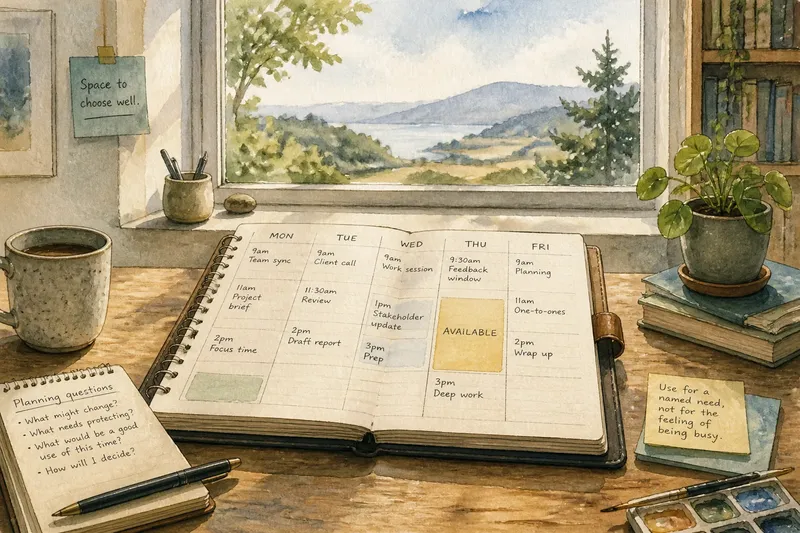
Use a calendar for fixed events, appointments, travel, scheduled calls, and actual deadlines. A calendar block can also protect focused work that needs a particular window, even when no outside party has set a due date.
For example, “read the proposal and note questions” is a clearer block than “prepare for meeting.” It names the work and gives you a visible stopping point. The block reserves time; it does not make the task more important by itself.
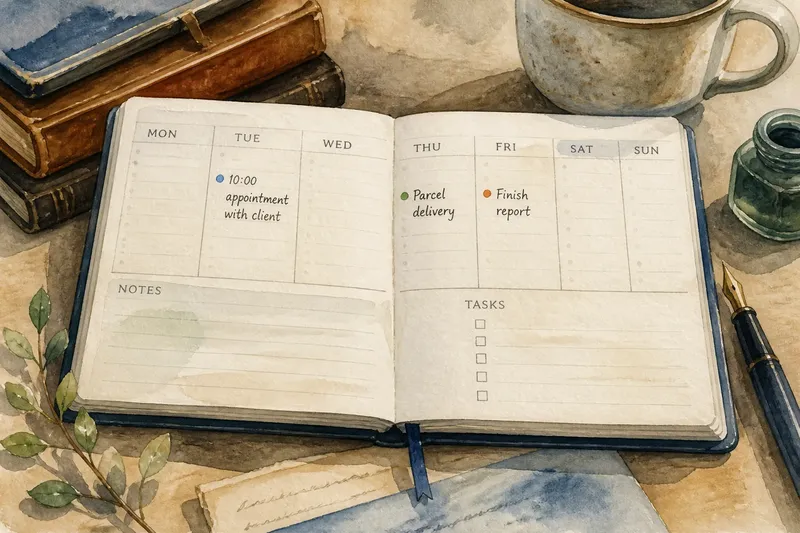
Separate a deadline from a work session. Put the due date on the calendar, then schedule a session only if the work needs protected time. “Send the signed form by Friday” is the deadline; locating the document and checking its details are actions that may or may not need blocks.
Keep deadlines distinct from preferred days
A deadline comes from an external requirement: a form closes, a package must be mailed, or a colleague needs a draft before review. A preferred day is an intention. It may be useful, but writing it in a calendar box does not turn it into an obligation.
Ask what happens if the task moves. If a specific consequence follows, record the actual due date and plan backward from it. If nothing external changes, keep the task on the list or mark the calendar session as a target.
This distinction keeps the calendar from treating every intention as an emergency. It also lets you tell which entries are fixed and which can be reconsidered when plans change.
Connect the list and calendar without duplicating them
Let the list describe the work and the calendar describe its timing. If a listed task gets a block, mark it as scheduled so it does not look like a second, separate obligation.
A simple notation is enough: an empty box for unscheduled work, a dot for work with a reserved block, and a check for completed work. The marks should make the plan easier to read, not create a small arts-and-crafts department.
When a block moves, update the calendar and the list so they still agree. If the task remains important, choose another workable time or return it to the unscheduled list. If it no longer belongs in the active plan, remove it rather than letting it become decorative guilt.
Paper and digital tools can coexist. A notebook may keep a working list close at hand, while a shared digital calendar makes appointments visible to others. Choose the format that helps you find the information when you need it.
What should you do when the calendar is already full?
Should every listed task get a block?
No. Give a block to work that needs a particular window, a deadline, or protection from interruption; leave ordinary flexible work on the list. Turning every small action into an appointment can make the day hard to adjust.
What if a deadline has no clear duration?
Keep the due date visible and schedule an initial session to inspect the requirements or materials. Use what that session reveals to decide whether the task needs another block.
What if there is no room for deadline work?
The plan has exposed a conflict. Consider asking for help, reducing the scope, renegotiating the deadline, or moving another commitment; if none is possible, seek advice from the person responsible for the deadline.
When should a task leave the active plan?
If a flexible task has no near-term consequence, decide whether it belongs later, somewhere else, or nowhere. Removing it is often more informative than letting it remain on the list indefinitely.
Before squeezing more items into the calendar, identify which entries are fixed, which can move, and which can be reduced or declined. A task list cannot create capacity, and a calendar block cannot settle a conflict by being drawn neatly.
Use a worked example to choose the right record
Say you need to send a signed library form by Friday, return a book, and prepare questions for Monday’s meeting. Assume, for this invented example, that the library deadline is real, the book return has no immediate due date, and the meeting preparation requires uninterrupted attention.
- Write “find the library form and check the instructions” on the list, since it is the next action and its duration is unknown.
- Put Friday’s submission deadline on the calendar, because it is a fixed boundary rather than a preferred workday.
- After finding the form, suppose you see that it needs a signature and a mailing address. Add “get signature and address envelope” as the next list action; the observable result is a form ready to send.
- Reserve a calendar session for “read proposal and write meeting questions,” because this invented task needs focused attention before Monday.
- Keep “return the book” on the list without a block, since the stated starting conditions give it no fixed time requirement.
The resulting plan distinguishes a real deadline, a focused session, and a flexible errand. If the form turns out to require another person’s approval, the next decision is to contact that person promptly and reassess whether Friday remains workable.
Make each planning entry lead to a decision
- Check whether a task has an outside deadline. If it does, put the due date on the calendar; if it does not, keep it on the list unless a reserved work session is needed.
- Check whether the task needs a specific time or uninterrupted attention. If it does, block a realistic session; if it does not, leave it flexible on the list.
- Check whether the task wording names an action and object. If it does, keep the entry; if it does not, rewrite it as a next action before scheduling it.
- Check whether a task with a block is still marked as unscheduled. If it is, mark it as scheduled; if it is not, leave the list alone so the task is not counted twice.
- Check whether a moved block still serves the same priority. If it does, choose another workable time; if it does not, return the task to the list or remove it from the active plan.
- Check whether a full calendar leaves a deadline without work time. If it does, discuss scope, help, or timing with the relevant person; if it does not, avoid adding blocks that merely crowd the day.
For a paper list or calendar block, use the list to keep flexible actions visible and the calendar to show fixed timing or protected work. Then make one useful correction: clarify an entry, distinguish a due date from a target, or update a block that no longer fits.