Before the Planner: A Short History of the Week at a Glance
The history of the week-at-a-glance planner shows how a compact page made recurring dates easier to scan and offered a distinct tool for personal notes.
The week-at-a-glance planner has a modest history: it adapted the familiar calendar grid to personal scheduling, giving readers room to write beside dates. That distinction matters because a printed calendar and a personal planner are related objects, not interchangeable stages in a tidy march of progress.
The seven-day week predates the planner
The seven-day week is older than printed personal planning. Its familiar sequence developed through ancient cultural and religious traditions, and institutions later used recurring weekly cycles to organize worship, commerce, schooling and work.
Those customs established the week as a shared way to name and order time. They did not require a particular kind of notebook: a weekly rhythm could be kept through practice, spoken reminders or records organized for other purposes.
Printed calendars made dates visible together
Printed calendars arranged dates in a repeatable visual form. A wall calendar or desk calendar could help a household or office locate a date and mark an appointment, but its grid was designed primarily to display the calendar itself.
Personal diaries and appointment books served a different purpose. Their entries could record plans or events in a person’s own words, often in pages arranged by date. The formats varied, so there was no single historical sequence in which one kind of book simply replaced another.
The week-at-a-glance page brought a calendar-like span of dates into a personal planning format. It offered a compact way to write across several days without turning through a daily diary, though its exact layout depended on the publisher and the needs of its readers.
Weekly layouts gave personal schedules a wider frame
A weekly spread can take the form of day columns, day rows or a compact date grid. These are design choices, not evidence of one universal path of development. Each affects how much writing space is available and how quickly dates can be compared.
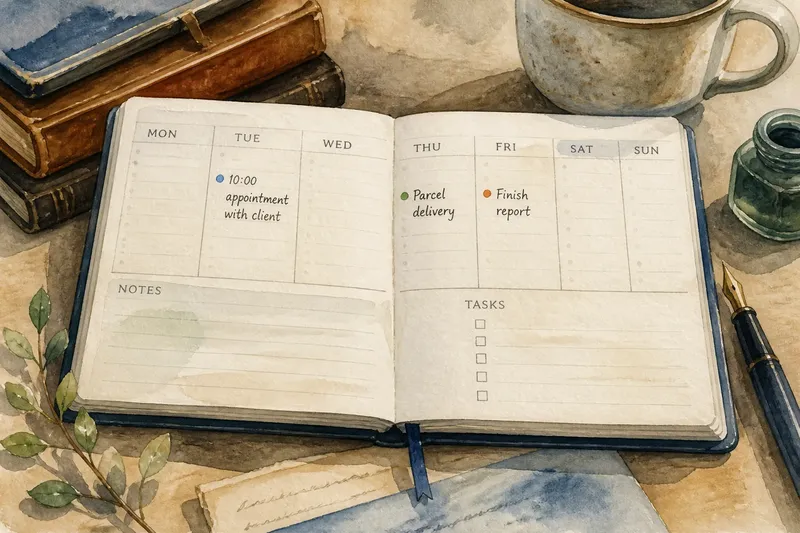
Some planners also divide the page into areas for appointments, notes or tasks. Such divisions make the page more than a miniature calendar, while the limited space keeps it from becoming a complete record of everything a person might do.
Imagine a reader with a Tuesday appointment, a Thursday parcel delivery and a report due by Friday. In a hypothetical weekly spread, the reader writes the appointment on Tuesday, marks the delivery on Thursday and places “finish report” beside Friday. The resulting page shows three dates and their proximity; it does not claim to show how long the report will take or whether the delivery will arrive on schedule.
Look at the page’s divisions before deciding what to write in them.
How is a weekly planner different from related books?
What does a weekly planner show that a daily diary does not?
A weekly planner places several dates on the same spread, so a reader can scan the sequence without turning pages. A daily diary usually gives one date more space for detailed notes.
How is a weekly planner different from a calendar?
A calendar chiefly presents dates and may be used to mark events. A weekly planner is a personal writing format that may provide space for appointments, notes and intentions alongside those dates.
What is a week-at-a-glance layout?
It is a page or spread that presents a week’s dates together. The design may use columns, rows or a grid, with differing amounts of room for writing.
Why do weekly planner formats vary?
Publishers choose different arrangements to balance date visibility, writing space and categories such as appointments or notes. A compact grid favors a quick scan, while larger day areas leave more room for entries.
The format’s history is a history of page design
The week-at-a-glance planner did not invent weekly timekeeping, and its origin cannot be reduced to a single moment when a diary supposedly became a planner. Its recognizable feature is a layout decision: place a run of dates together in a personal book and make room for the owner’s entries.
That distinction also helps when reading old examples. A weekly page is evidence of how a publisher chose to organize dates and writing space; by itself, it does not establish how every reader used the book or how planning habits changed across society.
To identify a week-at-a-glance planner, inspect the spread rather than relying on its cover label: dates for several consecutive days should be visible together, with space intended for personal entries. That simple test separates the format from a calendar page that merely happens to display a week.